

Do You Need to Be Fit and Strong to Kitesurf?

If you’ve watched kitesurfers launch off waves and wondered whether you’d need to be some kind of athlete to try it, you’re asking the right question — just maybe expecting the wrong answer. Do you need to be fit or strong to kitesurf? The honest answer is no, not in the way most beginners assume. Kitesurfing looks like a strength sport from the beach, but the mechanics tell a different story once you’re actually harnessed in.
That doesn’t mean fitness is irrelevant — it just plays a different role than people expect. In this guide, we’ll break down exactly what physical demands kitesurfing really places on your body, which muscles actually matter, why upper-body strength is far less important than beginners think, and how your fitness level affects your learning curve rather than your ability to do the sport at all. By the end, you’ll know exactly what to expect physically before your first lesson.
The Short Answer: No, But It Helps
Kitesurfing does not require you to be strong or exceptionally fit to get started. The kite’s pull is transferred through a harness attached around your hips or waist, not held by your arms — meaning your body weight and core, not your muscles, do most of the work of staying connected to the kite. Most first-time students describe their first lesson with the kite intimidating, but fysically feeling like a light workout, not a strength test.
That said, general fitness genuinely helps you progress faster and enjoy longer sessions. Riders with better cardiovascular endurance recover quicker between attempts, spend less time exhausted in the water, and can practice for longer stretches per session — which compounds into faster overall progress. Think of fitness less as a prerequisite and more as a progress multiplier: it won’t stop you from learning, but it will speed things up.
Beginners in average shape learn just as safely as athletic ones; the difference shows up in stamina during longer sessions, not in whether the sport is accessible to them at all.
Why the Harness Does Most of the Work

This is the detail that surprises almost every beginner: the control bar in your hands is only for steering. The actual pulling force of the kite runs through a line connected to your harness, which sits on your hips or waist, not your shoulders or arms. That’s a fundamentally different load path than, say, wakeboarding behind a boat, where your arms take continuous strain.
A waist harness sits higher and offers more freedom of movement but asks slightly more of your core, while a seat harness — often recommended for beginners — sits lower with leg straps, requiring less core engagement and taking real pressure off your lower back during longer sessions. Either way, your grip on the bar stays light; some experienced riders can steer with two fingers in steady wind.
This is also why people with lower-body or back limitations sometimes find kitesurfing more accessible than expected, since the sustained tension sits on the hips rather than the joints most other sports stress.
The Muscles That Actually Matter
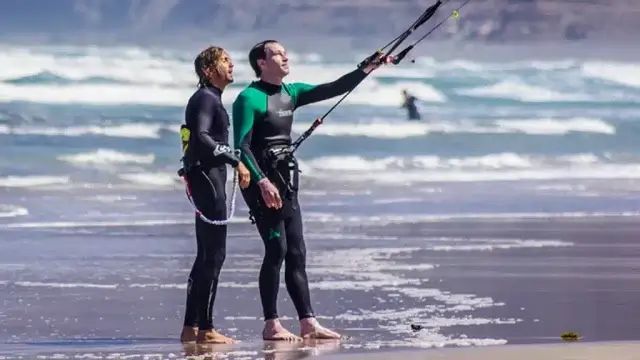
While raw strength isn’t the requirement, kitesurfing does engage specific muscle groups, and knowing which ones helps you understand what to expect physically.
Core strength matters most. Your abs and lower back stabilize your body against the kite’s pull and keep you balanced on the board, especially during water starts when you’re pulling your knees toward your chest while lying on your back in the water.
Leg strength comes into play once you’re riding, since your legs absorb the semi-squat stance used to control edge and speed on the board — similar to the burn you’d feel holding a wall-sit.
Cardiovascular endurance determines how long you can sustain a session, particularly relevant for water starts, which often take dozens of attempts and involve repeated swimming and re-launching.
Notably absent from that list: arm and shoulder strength, which beginners consistently overestimate the importance of before their first lesson.
What Beginners Underestimate: Coordination Over Strength

If strength isn’t the bottleneck, what actually determines how quickly someone learns? Overwhelmingly, it’s coordination — the ability to manage kite position, board angle, and body timing simultaneously. This is exactly why people with prior board-sport backgrounds — wakeboarding, snowboarding, surfing — often progress faster than stronger but less coordinated beginners, regardless of gym experience.
Balance and body awareness translate directly into faster water starts and steadier riding, while strength alone does very little to shortcut that learning curve. This is one of the more counterintuitive truths about the sport: a moderately fit person with good balance will typically outpace a much stronger person with no board-sport background.
How Kitesurfing Affects Your Fitness Over Time
Even though fitness isn’t a prerequisite, kitesurfing becomes a genuine full-body workout once you’re riding regularly. An active session can burn several hundred calories per hour, engaging your core, legs, and stabilizing muscles throughout. Many riders report noticeable improvements in core strength and cardiovascular fitness within their first season simply from time on the water, without any additional gym work.
This creates a positive feedback loop worth knowing about upfront: your first few sessions might leave you more tired than expected, but that fatigue fades quickly as your body adapts, typically within 3 to 5 sessions. Riders who stick with the sport often find their baseline fitness improves enough that what once felt demanding becomes comfortable, making longer sessions and eventually tricks or jumps far more accessible.
Quick Takeaways
- You do not need to be strong to kitesurf — the harness, not your arms, carries the kite’s pull.
- Core strength matters most; arm and shoulder strength barely factor in.
- General fitness speeds up progress and stamina, but doesn’t gate whether you can learn.
- Coordination and balance predict learning speed far better than raw strength does.
- A seat harness reduces core demand compared to a waist harness, helpful for beginners.
- Expect your first sessions to feel like a light-to-moderate workout, easing within a few sessions.
- Regular kitesurfing builds real fitness over time, even if you didn’t start particularly fit.
Conclusion
So, do you need to be fit or strong to kitesurf? Not to get started — and that’s genuinely good news for anyone who’s held back by the assumption that this is a strength sport reserved for athletes. The harness carries the load, your core does more work than your arms ever will, and coordination consistently beats raw power when it comes to how fast you progress.
Where fitness actually matters is in the experience along the way: better stamina means longer sessions, faster recovery between water-start attempts, and less fatigue while you’re still building the coordination that really drives your progress. None of that is a barrier to entry — it’s simply something that improves naturally the more time you spend on the water.
If concerns about fitness or strength have been holding you back from booking your first lesson, let this be the reminder that kitesurfing schools teach riders of every fitness level successfully, every season. Show up with reasonable general health, a willingness to fall a few times, and realistic expectations for your first couple of sessions — the rest genuinely comes with practice, not the gym.
Frequently Asked Questions
Do I need upper body strength to kitesurf? No. The kite’s pull runs through your harness to your hips, not your arms, so grip strength and arm power play a minimal role in controlling the kite.
Can out-of-shape beginners learn to kitesurf? Yes. Most kite schools teach beginners across a wide range of fitness levels successfully; the main difference is stamina during longer sessions, not the ability to learn the fundamentals.
What muscles get the most workout from kitesurfing? Your core and legs work the hardest, stabilizing your body against the kite’s pull and controlling your stance and edge on the board, while your arms stay relatively relaxed.
Is kitesurfing a good workout for losing weight or building fitness? Yes, an active kitesurfing session can burn several hundred calories per hour and engages your core, legs, and cardiovascular system, making it an effective full-body workout over time.
Does being athletic make you learn kitesurfing faster? Athleticism helps somewhat, but coordination and prior board-sport experience — like wakeboarding or snowboarding — typically predict faster progress more reliably than general strength or fitness alone.
Did your first kitesurfing session feel easier or harder than you expected, physically? Let us know in the comments, and share this with anyone who’s hesitating to try the sport because they think they’re “not fit enough.”
References
- IKSURFMAG — physical fitness and strength requirements for kitesurfing beginners
- Kiteboarding school reporting on harness mechanics, load distribution, and beginner fitness outcomes
- Watersport fitness and calorie-expenditure reporting from kiteboarding industry publications