

How Long Does It Take to Learn Kitesurfing?

If you’ve been standing on the beach watching kitesurfers glide past and wondering “could I actually do that, and how long would it take me?” — you’re not alone. It’s the single most common question new riders ask before booking their first lesson.
The honest answer: most people become an independent kitesurfer somewhere between 10 and 20 hours of lessons, usually spread across 3 to 6 sessions. Some riders get there faster, some take a bit longer, and a lot of that comes down to factors you can actually control. In this guide, we’ll break the learning process down stage by stage, walk through what genuinely speeds progress up (and what slows it down), and give you a realistic picture of what your first days of kitesurfing will actually look like.
The Short Answer: 10 to 20 Hours for Most Riders
Across kite schools worldwide, the numbers land in a fairly tight band. Most beginners need 10 to 20 hours of instruction to go from zero experience to riding independently — meaning you can launch your own kite, get up on the board, ride in both directions, and make it back to where you started without an instructor swimming next to you.
That usually breaks down into 3 to 6 lesson sessions of two to three hours each, often spread across three to five days. A handful of naturally athletic students with a background in wakeboarding, surfing, or sailing get there in as little as 6 to 8 hours. Others, especially those learning in inconsistent wind or squeezing lessons in once a month, can take 25 hours or more. Neither pace is “wrong” — kitesurfing rewards patience far more than raw athleticism.
Breaking Down the Kitesurfing Learning Stages
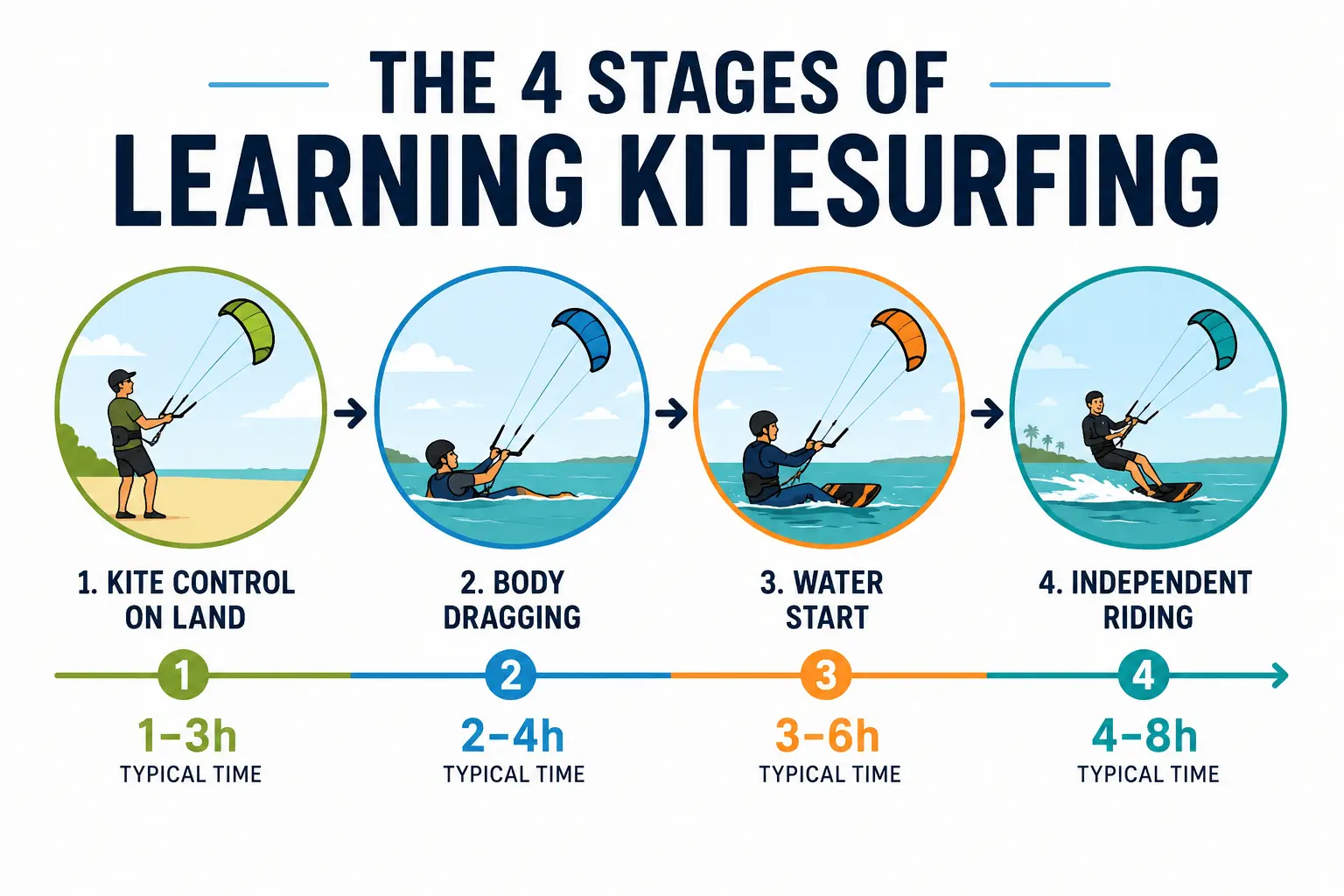
Rather than one long blur of lessons, kitesurfing instruction follows a fairly universal structure, closely mirroring the IKO (International Kiteboarding Organisation) progression used by certified schools globally.
Stage 1 — Kite Control on Land (1–3 hours)
Every kitesurfing lesson starts on dry sand, and for good reason. Before you ever touch a board, you need to understand the wind window, practice launching and landing safely, and build muscle memory for steering a trainer kite. This stage feels slow at the time, but it’s the foundation everything else is built on — skip it, and every later stage takes longer.
Stage 2 — Body Dragging in the Water (2–4 hours)
Next comes body dragging: using the kite’s pull to move through the water without a board underneath you. It looks unglamorous, but it’s arguably the most important beginner skill you’ll learn, since it’s exactly what lets you recover your board every single time you fall — and in the early days, you’ll fall a lot.
Stage 3 — Water Starts (3–6 hours)
This is the stage every beginner is desperate to reach: getting the board on your feet and popping up out of the water under kite power. Water starts are notoriously the biggest bottleneck in the whole learning curve. Most riders need dozens of attempts before it clicks, so don’t be discouraged if this stage eats more hours than you expected.
Stage 4 — Riding Independently Upwind (4–8 hours)
Once you can water start, the final stretch is about consistency: riding in both directions, controlling your speed, coming to a stop on demand, and — critically — riding upwind so you don’t drift miles down the beach. Reaching this stage is what most schools define as becoming an “independent rider.”
6 Factors That Affect How Fast You Learn
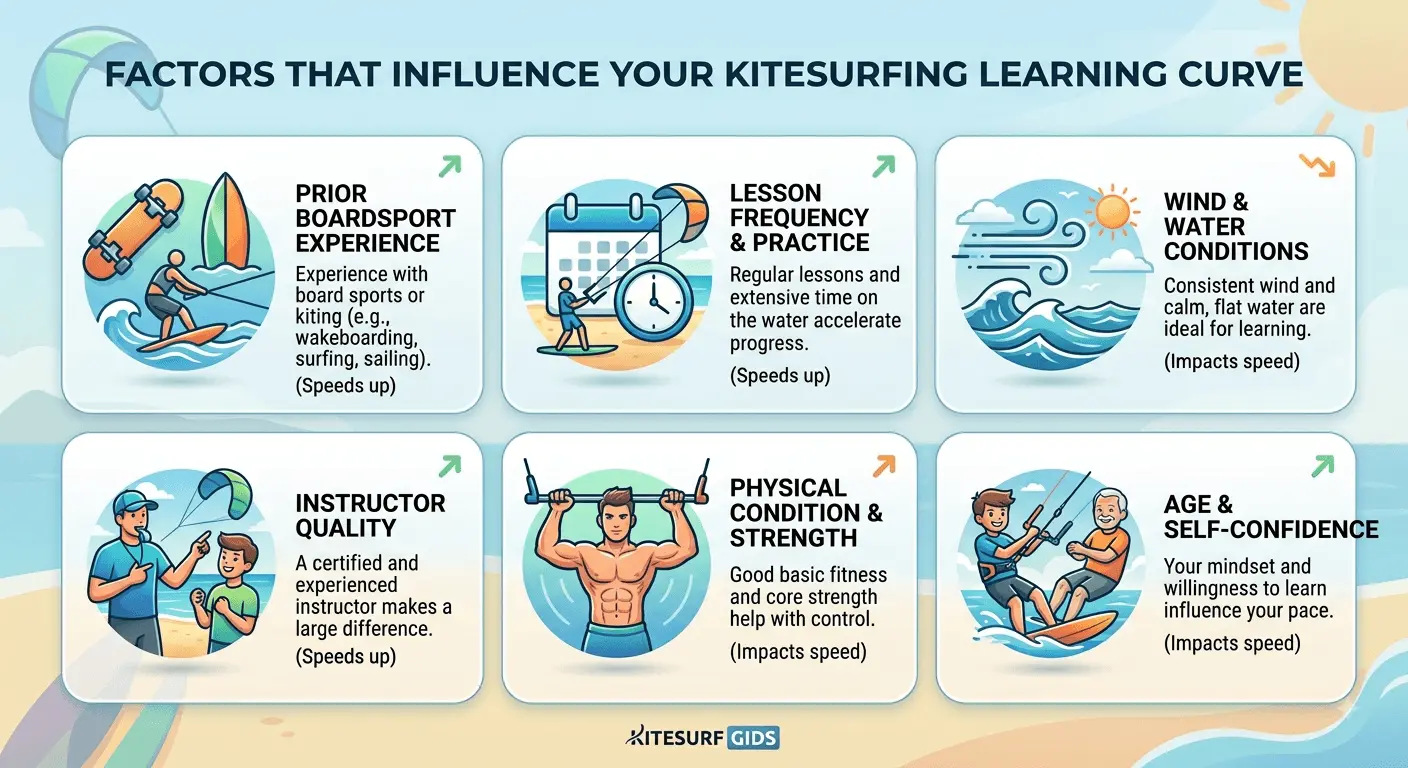
Not everyone progresses at the same rate, and it’s rarely about talent alone. Here’s what actually moves the needle:
- Prior board or sailing experience. Wakeboarders, surfers, snowboarders, and sailors typically progress faster because balance and reading wind or waves already feels familiar.
- Lesson frequency. Daily or back-to-back sessions beat one lesson a month, every time — kitesurfing is a coordination sport, and coordination fades quickly between sessions.
- Wind and water conditions. Learning in flat, shallow water with steady side-shore wind is dramatically easier than learning in gusty, choppy conditions.
- Instructor quality. One good correction can save you hours of repeating the same mistake.
- Fitness and comfort in water. You don’t need to be an athlete, but general fitness and being relaxed in open water both help.
- Age and fear tolerance. Kids and teens often learn quickly due to fearlessness, while older beginners sometimes progress faster once initial nerves settle.
Realistic Timeline: From First Lesson to First Solo Session
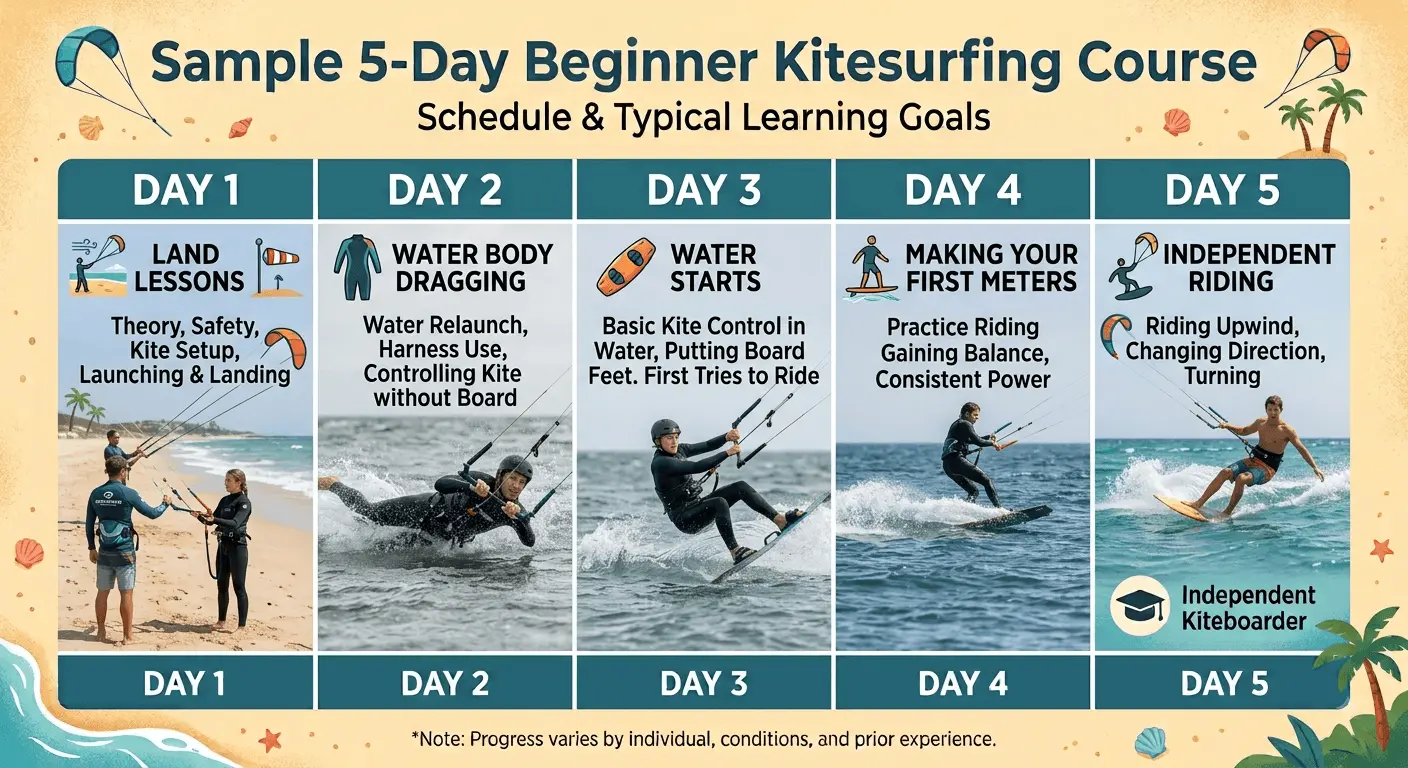
Here’s roughly what a compressed, multi-day beginner course looks like in practice:
Day 1 (2–3 hours): Kite theory, safety systems, and kite control on land. Day 2 (2–3 hours): Body dragging, board familiarization, first water start attempts. Day 3 (2–3 hours): More water starts, short rides in one direction. Days 4–5 (4–6 hours): Riding both directions, upwind riding, first solo session under supervision.
By the end of a focused week, most beginners are riding independently — even if it’s still a bit wobbly.
How to Learn Kitesurfing Faster (Without Cutting Corners)
- Book multiple consecutive days rather than spacing lessons weeks apart.
- Choose a spot with flat water and consistent wind for your first course — it removes variables you don’t need yet.
- Spend extra time on body dragging even after your instructor says you’re ready to move on; it pays off every time you fall.
- Watch videos of your own sessions when possible — seeing your mistakes speeds up correction dramatically.
- Take lessons from an IKO or equivalent certified school rather than learning informally from a friend; structured progression genuinely learns faster and safer.
Common Mistakes That Slow Down Beginners
The biggest one is rushing the board before kite control is solid — riders who skip ahead usually end up relearning fundamentals later anyway. The second is skipping lessons entirely and self-teaching with borrowed gear; without someone correcting small errors early, bad habits compound. And the third is inconsistent practice: two hours today, then nothing for a month, resets far more progress than people expect.
Quick Takeaways
- Most beginners reach independent riding in 10 to 20 hours of lessons, across 3–6 sessions.
- Learning follows four stages: land kite control, body dragging, water starts, then independent riding.
- Water starts are typically the biggest time sink in the whole process.
- Consistent, back-to-back lessons progress faster than spaced-out ones.
- Flat water and steady wind conditions meaningfully speed up learning.
- Prior board sports experience helps, but isn’t required to progress well.
- A certified instructor and structured course beat self-teaching, both in speed and safety.
Conclusion
So, how long does it take to learn kitesurfing? For most people, it’s a realistic 10 to 20 hours spread across less than a week of focused lessons — not the months-long undertaking many beginners assume. The stages are predictable, the bottlenecks are well known, and with the right instructor, decent conditions, and a bit of patience through the water-start stage, you’ll be riding independently faster than you probably think. If you’re ready to start, look for an IKO or equivalent certified school near you, and consider booking 3–5 consecutive days rather than spreading lessons out — it’s the single biggest lever you have over your own learning curve.
Frequently Asked Questions
Can I learn kitesurfing in a single day? It’s rare but not impossible for very athletic beginners with board-sport experience and ideal conditions. Most riders need at least 2–3 days of lessons to reach a first proper water start.
Do I need to be fit to learn kitesurfing? General fitness helps, especially core strength and comfort swimming, but you don’t need to be an elite athlete. Technique and timing matter far more than raw strength.
Is kitesurfing harder to learn than windsurfing? Most instructors consider kitesurfing’s early stages easier to pick up since the kite does most of the work, though windsurfing balance sometimes feels more intuitive at first. Both have their own learning curve.
How many lessons do I actually need before I can kitesurf on my own? Most schools estimate 3 to 6 lessons, roughly 10–20 hours total, before you’re considered an independent rider able to launch, ride, and land safely without supervision.
What’s the hardest part of learning to kitesurf? Almost universally, beginners find the water start the hardest stage — coordinating kite power, board position, and body timing takes more attempts than any other single skill in the sport.
Did this timeline match your own kitesurfing journey — faster, slower, or right on the money? Drop a comment below and let us know how many hours it took you to ride independently, and share this guide with a friend who’s thinking about their first lesson.
References
- International Kiteboarding Organisation (IKO) — official student progression and certification levels
- Kitesurfing school progression guides (multiple IKO-affiliated schools, 2025–2026 course data)
- Industry-reported average lesson-hour ranges from certified kite schools across Europe, Egypt, and Latin America